Downy mildew, powdery mildew, botrytis: these three fungi account for the majority of crop losses in vineyards in France. Choosing the right treatment for vine diseases involves comparing the effectiveness of active substances, their impact on the soil, and their compatibility with a strategy for reducing inputs. This article measures the differences between conventional, organic, and agronomic approaches, supported by recent data.
Copper vs. sulfur: comparison of active substances for fungal diseases of the vine
Copper (Bordeaux mixture) and sulfur remain the two pillars of antifungal treatment in viticulture, including in organic farming. Their targets are not the same, nor are their limitations.
| Criterion | Copper (Bordeaux mixture) | Wettable sulfur |
|---|---|---|
| Target disease | Downy mildew (Plasmopara viticola) | Powdery mildew (Erysiphe necator) |
| Mode of action | Contact, preventive | Contact, preventive, and partially curative |
| Effect on soil | Accumulation of copper in the surface horizons | Low persistence, rapid degradation |
| Organic regulatory constraint | Annual ceiling limited by European regulation | No specific ceiling in organic |
| Limit of effectiveness | Beyond approximately 300 g of metallic copper/ha/application, effectiveness does not increase | Loss of effectiveness above 35 °C (leaf burn) |
Le Monde reports that organic winegrowers are seeking to protect their vines from downy mildew with less copper, favoring preventive strategies rather than curative treatments. This ceiling of approximately 300 g of metallic copper per hectare per application, beyond which effectiveness plateaus, serves as a technical benchmark to remember when treating vine diseases.
Sulfur, on the other hand, retains an advantage over powdery mildew due to its partially curative action. Its main weakness remains sensitivity to heat: at high temperatures, it causes burns on leaves and clusters.
Agronomic levers: reducing fungal pressure before treatment
The current trend in viticulture shifts the focus from treatment to prevention. Several vine management practices directly reduce the conditions favorable to downy and powdery mildew, without resorting to a phytosanitary product.
Canopy management and trellising
Stagnant moisture in the foliage is the primary factor for the development of downy mildew. Careful trellising, combined with targeted leaf removal in the cluster area, improves air circulation and accelerates leaf drying after rain.
In warmer climates, trellising plays a dual role: it limits the humidity conducive to fungi while protecting clusters from sunburn. Some winegrowers are already adapting the height and orientation of their canopy to meet these two simultaneous constraints.
Pruning and aeration of the vines
A pruning strategy that promotes spacing between shoots mechanically reduces the wetting time of plant organs. This approach is particularly relevant against botrytis (gray rot), whose development closely depends on prolonged contact between clusters and wet foliage.
- Leaf removal in the fruiting zone as soon as the berries set to expose the clusters to open air
- Early bud thinning to limit plant density and excessive shade
- Controlled cover cropping in the inter-row, which regulates soil moisture without competing with the vine during dry periods
These agronomic levers do not replace treatments, but they reduce the number of necessary applications. Combined with precise weather monitoring, they allow for spraying to be triggered at the right moment rather than according to a fixed schedule.
Drone spraying: how application precision changes the game
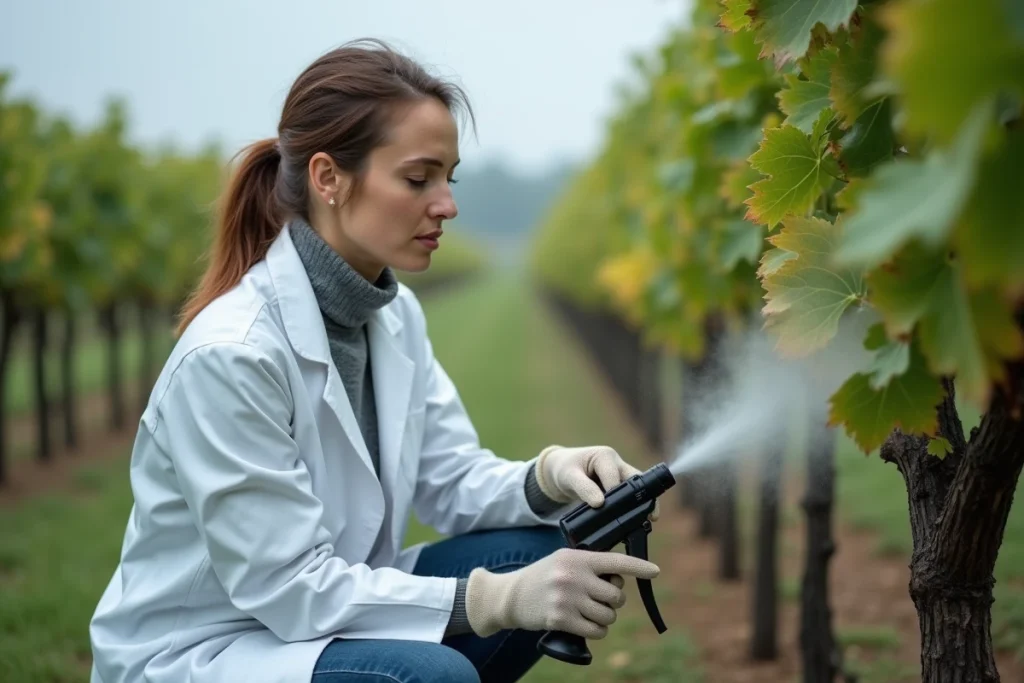
L’Union reported in June 2026 on an experiment in Champagne using a spraying drone applying a natural treatment against vine diseases. This type of device targets the canopy from above, with a precision that towed sprayers cannot achieve on sloped or densely planted plots.
The drone reduces product drift and limits the volume of spray per hectare. In hillside vineyards, where the passage of heavy machinery compacts the soil and damages the rows, this technology represents a measurable operational gain.
The Champagne experiment remains isolated at this stage, and French regulations strictly govern aerial application. The use of drones does not replace a comprehensive treatment program, but it opens a pathway for hard-to-access plots and low-dose biocontrol product applications.

Integrated treatment strategy: articulating chemistry, biology, and agronomy
An effective program against vine diseases never relies on a single substance. Alternating modes of action (contact, penetrating, systemic in conventional) limits the risk of resistance in fungi, a documented problem with powdery mildew and certain families of fungicides.
- Position copper strictly preventively, before announced rainy episodes, without exceeding the effectiveness threshold per application
- Alternate sulfur and biocontrol products on powdery mildew to reduce selection pressure
- Integrate weather data (downy mildew forecasting models) to space treatments when the risk is low
- Complement with agronomic levers (leaf removal, trellising, cover crop management) to lower baseline fungal pressure
Reducing the number of treatments comes from better positioning them, not from eliminating them. A winegrower who treats six times at the right moment better protects their vines than another who treats ten times according to a rigid schedule.
Vineyards facing black rot or esca add an additional layer of complexity: black rot requires very early interventions on leaves, while esca, a wood disease, does not respond to any approved curative treatment and is mainly managed through restorative pruning and replacing affected vines.
The choice of a treatment strategy depends on the grape variety, the terroir, the local climate, and the health history of each plot. Data collected season after season – pest pressure, phenological stages, rainfall accumulation – remain the best decision-making tool for adjusting interventions and reducing doses without compromising the harvest.