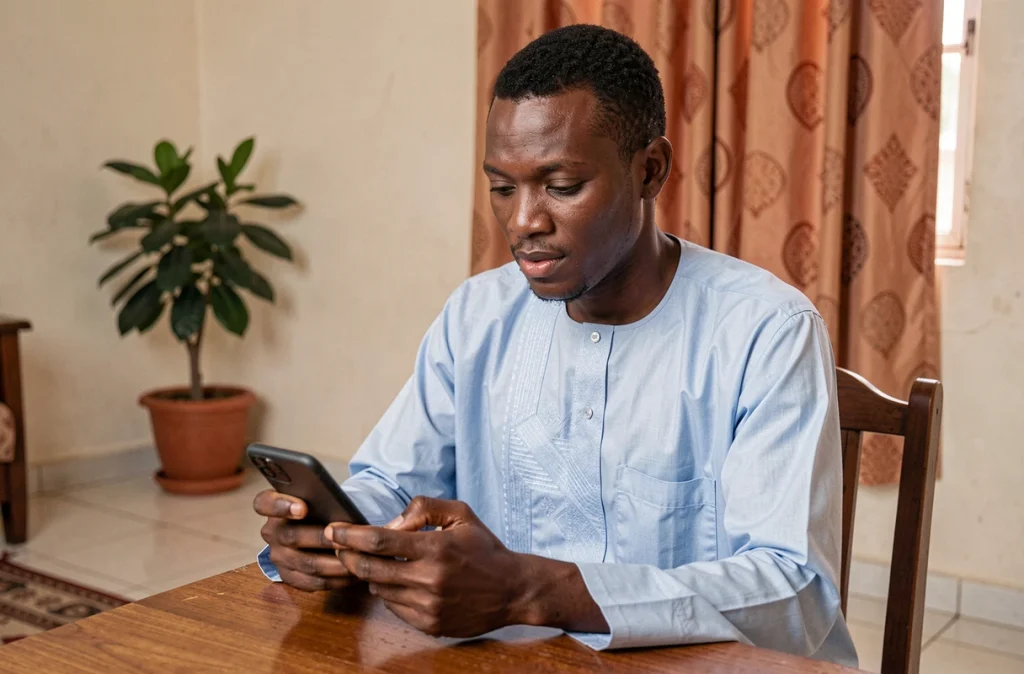
A merchant in Thiès receives an urgent order for goods, but his working capital is tied up in an ongoing delivery. He needs cash within a few hours, not in two weeks. This is exactly the type of situation where borrowing via Wave in Senegal makes perfect sense: quick financing, disbursed directly to the mobile wallet, without going through a bank branch.
Wave as a disbursement channel: what it concretely changes
Wave is not a bank. It is an electronic money issuer, partnered with UBA Senegal for managing flows. This distinction matters because it determines the nature of the loans available.
You do not subscribe to a traditional loan directly in the Wave app as you would on a banking portal. In practice, the loan is routed through a financial partner (microfinance institution, fintech, public program) that uses Wave as the disbursement and repayment channel. The Wave wallet serves as a conduit, not a lender.
This mechanism makes the operation quick: no interbank transfer, no check to cash. The money arrives in the Wave account within minutes, immediately usable for a transfer, a purchase from a merchant, or a withdrawal from an agent.
For those looking to understand how to obtain a Wave loan in Senegal, this electronic money disbursement mechanism is the starting point to grasp before taking any steps.
Nano-credit and micro-credit via the DER/FJ: the most accessible circuit

The General Delegation for Rapid Entrepreneurship (DER/FJ) uses Wave as a channel for deploying nano-credit and micro-credit across the Senegalese territory. This partnership allows for the dematerialized distribution of small loans to micro-entrepreneurs, without requiring a traditional bank account.
Wave has injected 100 million FCFA into the Rose Fund, a scheme dedicated to the economic empowerment of women. This fund targets modest amounts with simplified procedures, disbursed and repaid via the Wave wallet.
In practice, this means that a market vendor or a grain processor can access credit without ever stepping into a bank. Repayment is made by automatic deduction from the Wave balance, according to a schedule defined at the time of granting.
Field eligibility conditions
Feedback varies on the specific criteria depending on the program and the region, but there is a common foundation in most schemes:
- Having an active Wave account for several months, with a regular transaction history (deposits, merchant payments, transfers)
- Engaging in an income-generating activity, even informal, verifiable by the transaction history on the wallet
- Not having any outstanding payments on a previous nano-credit or micro-credit distributed via the same channel
- Providing a valid ID corresponding to the holder of the Wave account
The transaction history replaces the bank statement. This is the decisive criterion. An active wallet with regular flows weighs more than a payslip in this circuit.
Financing purchases in installments: the alternative to personal loans
Some Senegalese e-commerce platforms offer integrated financing via Wave, without going through a separate credit application. The principle is simple: choose an eligible product, select the number of installments, and the payment is automatically divided.
This type of financing generally works over short durations, between two and four weekly payments. The interest rate varies according to the number of installments chosen, and it is displayed before validation, which avoids unpleasant surprises.
This is not a loan in the traditional sense. You do not receive money in your account. The supplier is paid directly, and the buyer repays through successive deductions from their Wave balance. For a purchase of a phone, household appliance, or professional equipment, this formula replaces a traditional consumer credit without bank paperwork.
What to check before validating
The total cost depends on the number of installments. The more you spread it out, the higher the additional cost. You need to compare the cash price and the financed price to measure the true cost of credit.
You also need to check that the Wave balance will be sufficient on the deduction dates. A rejected deduction can block access to future financing, which closes a door that is difficult to reopen.
BCEAO regulation and security of digital loans in Senegal

The BCEAO regulates electronic money issuers in the UEMOA zone and is currently reviewing the instructions governing digital credit. This tightening of regulations has a direct impact on the conditions for granting loans distributed via Wave.
In concrete terms, partner institutions must comply with transparency obligations regarding rates, fees, and repayment conditions. A loan granted via Wave by a licensed microfinance institution offers the same regulatory guarantees as a loan distributed in a branch.
Checking that the credit provider is licensed by the BCEAO remains the minimum precaution. Loan offers circulate on social media without any licensing, with opaque rates and aggressive collection practices. If the lender cannot provide their license number, it’s best to walk away.
Protecting your Wave account during the process
Never share your Wave secret code with a third party, even if they claim to be a credit agent. Disbursement goes through the system, not through a manual transfer to an intermediary.
- Never share your Wave PIN or password with a supposed credit advisor
- Check that the lender appears on the list of licensed partners of the BCEAO or DER/FJ
- Keep a screenshot of each transaction related to the loan (disbursement, installments, remaining balance)
Borrowing via Wave in Senegal simplifies access to credit for millions of people excluded from the traditional banking circuit. The speed of disbursement and the flexibility of repayment on a mobile wallet change the game, provided you check the lender’s licensing and maintain a clean transaction history. The rest is just repayment discipline.