Choosing tires for a custom motorcycle is not just about finding an aesthetic profile that matches the style of the machine. Technical compatibility (structure, dimensions, load and speed indices) filters options well before the choice of a brand or tread pattern. This guide reviews the measurable criteria that separate a suitable setup from a shaky compromise.
Bias or radial structure on custom motorcycles: what the choice changes at the handlebars
Most customs ride on bias-ply tires. The carcass plies cross at an angle, resulting in a stiff sidewall and high load capacity. This is the historical construction of Harley-Davidson, Indian, and the majority of Japanese cruisers.
Radial tires, on the other hand, have plies perpendicular to the rolling axis, covered by a crown belt. The result: a softer sidewall and superior stability at high speeds. However, on a heavy, low custom that is used at moderate revs, this flexibility does not always provide a tangible benefit.
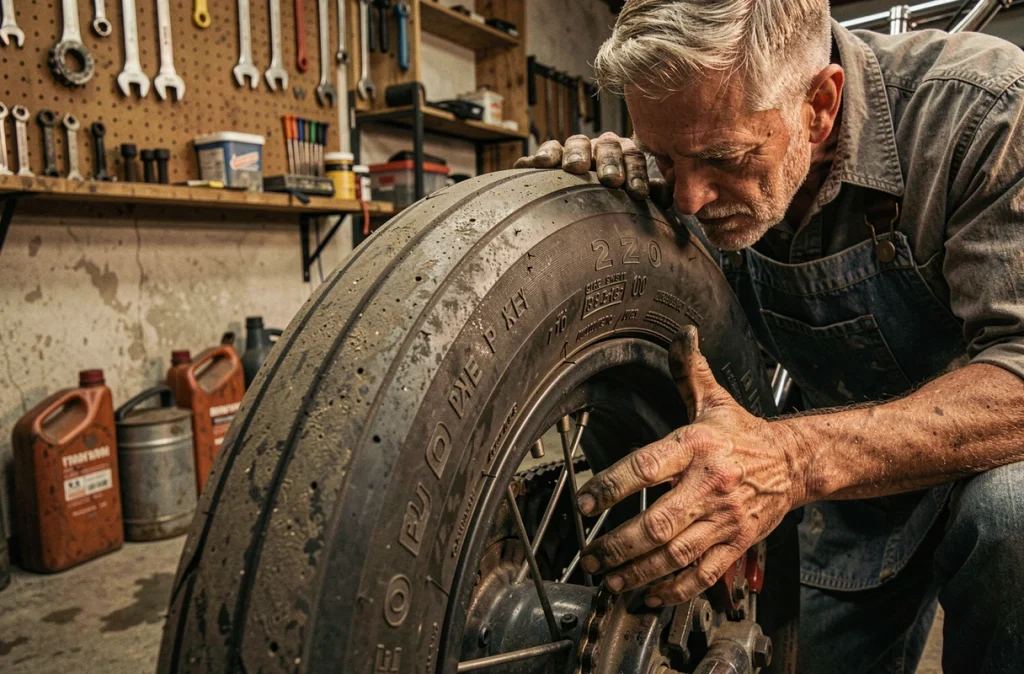
The main point of caution remains the manufacturer’s approval. Fitting a radial tire on a rim designed for bias (or vice versa) alters the contact geometry and cornering behavior. Before making any decision, check the recommendation printed on the sidewall of the original tire or in the motorcycle’s maintenance manual.
To delve deeper into the models suitable for each type of cruiser, the guide to custom motorcycle tires details the ranges brand by brand with their carcass specifications.
Comparison of custom ranges: Michelin, Metzeler, Pirelli, Dunlop
The four manufacturers dominating the custom segment each offer a different philosophy. The table below summarizes the differentiation axes on the most common models.
| Model | Construction | Strength | Main Limitation |
|---|---|---|---|
| Michelin Commander III Cruiser | Bias | Longevity, wet grip | Slower warm-up |
| Metzeler ME 888 Marathon Ultra | Bias | Very high lifespan | Significantly heavier tire |
| Pirelli Night Dragon | Bias | Stability under load, sporty look | High segment price |
| Dunlop D404 | Bias | Accessible price, versatility | Wet grip is lacking |
The Michelin Commander III and the Metzeler ME 888 compete for the top spot in longevity. The Metzeler ME 888 boasts the longest lifespan in the segment, making it a frequent choice for high-mileage riders. The Michelin Commander III compensates with better performance on wet pavement.
Conversely, the Dunlop D404 positions itself on a tight value-for-money ratio, with decent dry road grip but performance dropping off as soon as the pavement is wet. The Pirelli Night Dragon targets sport customs (like Power Cruisers) where stability under load and grip in curves matter more than mileage.
Dimensions and indices: the filters to check before purchase
The most common mistake is choosing a tire based solely on width. On a custom motorcycle, four parameters must match simultaneously:
- The complete dimension (width, aspect ratio, and rim diameter), readable on the sidewall of the original tire, for example, 130/90-16.
- The load index, which ensures that the tire can support the weight of the motorcycle, the rider, the passenger, and the luggage. A load index that is too low compromises handling and accelerates wear.
- The speed index, coded by a letter (H, V, W). On customs, an H index is sufficient in the vast majority of cases, but it must remain equal to or higher than the manufacturer’s recommendation.
- The manufacturer’s approval (sometimes a specific marking on the sidewall), which certifies that the tire has been tested on the exact model of the motorcycle.
Michelin also offers tire selections by vehicle, including model year, which simplifies compatibility verification. Cross-referencing the dimension with the load index avoids most mounting errors.
Custom motorcycle tire pressure: the most neglected parameter
Recent guides place pressure at the same level of attention as the choice of the tire itself. On a loaded custom (two-up, saddlebags, top case), a difference of a few tenths of a bar alters the contact patch on the ground and degrades cornering behavior.
Check when cold, with the engine off for at least two hours. A warm tire naturally shows a higher pressure, which skews the measurement. The reference value is found on a label affixed to the swingarm or in the owner’s manual.
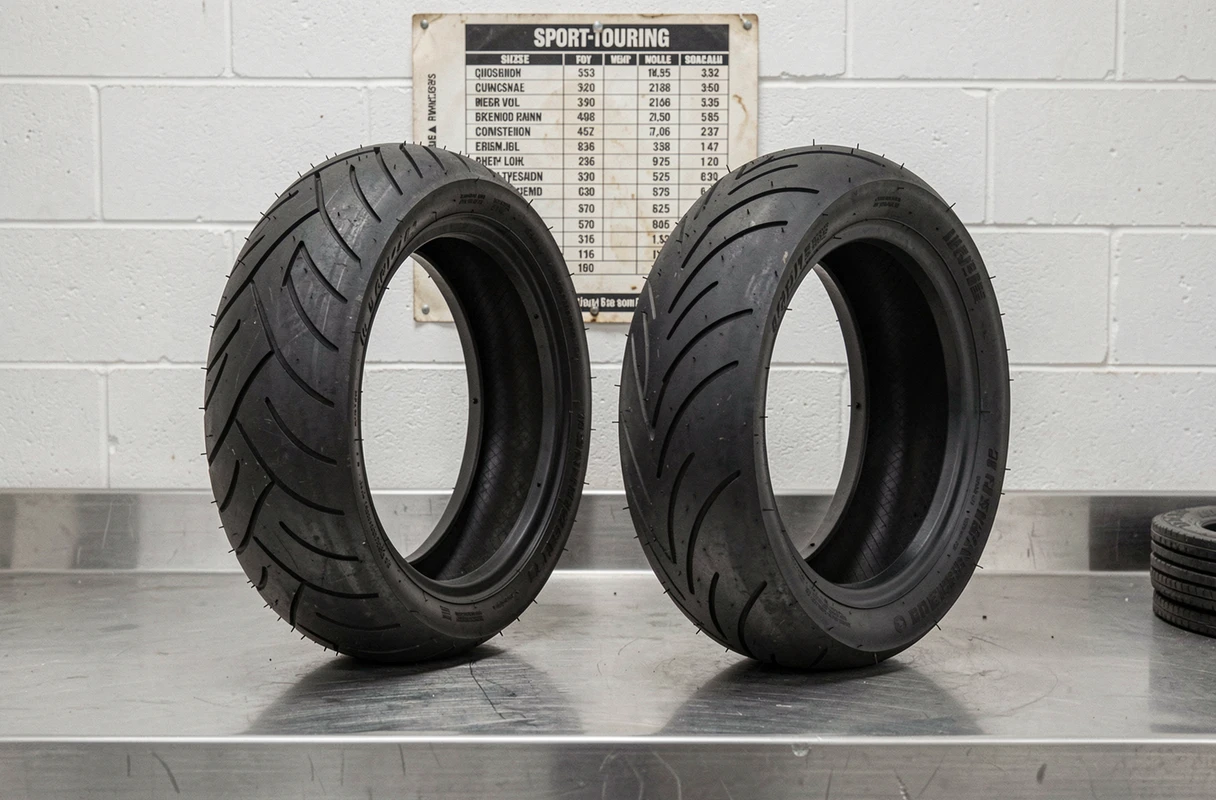
The visual aging of the tire also deserves regular examination. Micro-cracks on the sidewalls, even with a still thick tread, indicate hardened rubber that has lost some of its grip. On a custom motorcycle that is ridden little but remains exposed to UV rays, this phenomenon can sometimes appear before mechanical wear.
Asymmetrical wear: a warning signal
More pronounced wear in the center of the tread indicates almost exclusively straight-line use, common on long highway trips typical of cruisers. This central wear reduces stability in curves long before the tire appears “finished”. If the tire profile visibly flattens, replacement is necessary even if the tread depth remains legal.
The choice of a custom tire relies on a sequence of technical filters (structure, dimensions, indices, pressure) that precede the question of the brand. A Metzeler ME 888 on an unsuitable motorcycle will perform worse than a Dunlop D404 mounted to the correct specifications. The deciding factor, ultimately, remains verified compatibility with the exact model of the machine.