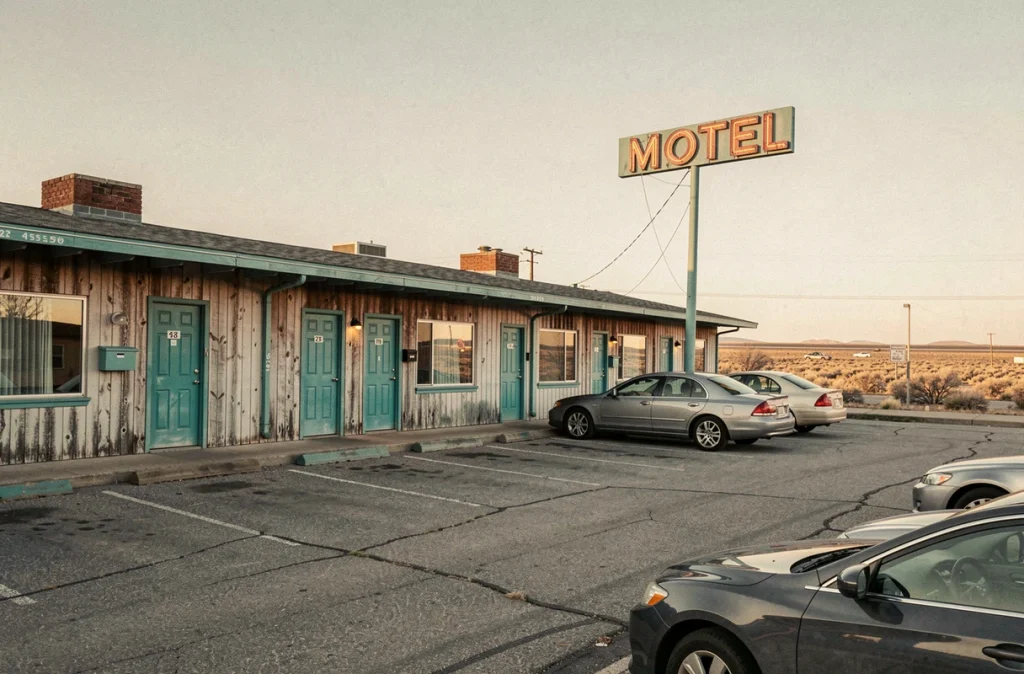
You have been driving for several hours on an American or Canadian highway. You are looking for a place to sleep, and two options appear: a roadside motel and a downtown hotel. The price, access, and level of comfort will be quite different. Understanding what separates a motel from a hotel helps avoid unpleasant surprises, especially when budget or safety are concerns.
Architecture and access to rooms: the criterion travelers underestimate
The most concrete distinction between a motel and a hotel lies not in the price or the number of stars. It is about how you access your room.
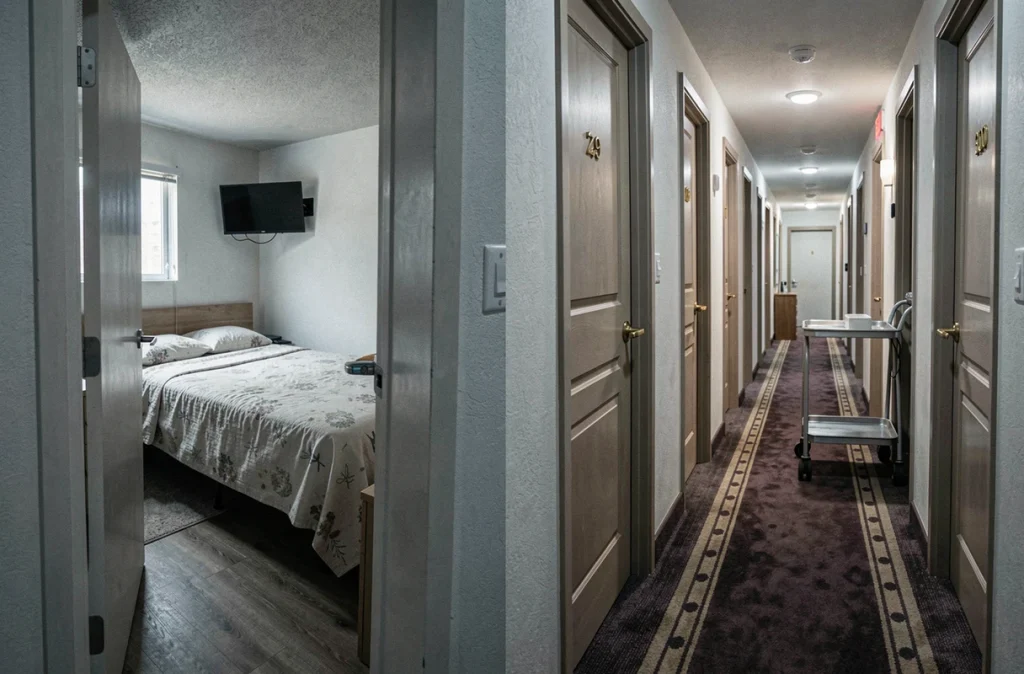
In a hotel, you go through a lobby, an interior hallway, sometimes an elevator. All traffic occurs inside the building. The reception staff sees who comes in and who goes out. The floors are often accessible only by key card.
In a motel, the logic is reversed. Each room opens directly to the outside, generally facing the parking lot. You park your car in front of the door, and you enter. No lobby, no hallway. This design dates back to the 1920s in the United States when the word “motel” was coined from the contraction of “motor” and “hotel” to describe accommodations designed for passing motorists.
To fully grasp the difference between a motel and a hotel, one must start from this architectural reality: it conditions everything else, from the feeling of safety to the services offered.

Safety in motels and hotels: how exterior access changes things
Have you ever noticed that motels give a total impression of openness? It’s not just an impression. Direct exterior access alters the control of comings and goings.
A hotel with interior corridors naturally filters visitors. The lobby serves as a mandatory passage point. Cameras cover the hallways. The floor doors are locked. In a motel, anyone can walk along the rooms without being identified, as the doors open to an open space.
The reception also plays a role. In a hotel, it operates continuously. In a motel, the hours are often limited, sometimes restricted to the evening. After a certain hour, there is no one at the front desk.
Some concrete guidelines to assess the safety of a motel
- Check if the reception is open at your arrival time, especially if you are traveling at night
- Look at the lighting of the parking lot and outdoor walkways in photos or reviews
- Prefer motels from well-known chains that impose minimum surveillance standards
The safety of a motel is not inherently bad. It simply relies on a different, less regulated model, where the traveler must be a bit more vigilant.
Services in hotels and motels: two philosophies of accommodation
A hotel sells an experience. A motel sells a night of sleep. This distinction summarizes the difference in services between the two.
The motel operates on a minimalist exploitation logic. The rooms are clean, equipped with the bare essentials (bed, bathroom, sometimes a small refrigerator). Breakfast, when it exists, is limited to coffee and a few pastries. There is no restaurant, gym, or concierge service.
The hotel offers a wider range of services, which varies by category:
- On-site restaurant, room service, bar
- Pool, fitness room, spa in higher-end establishments
- Concierge service, luggage storage, airport shuttles
- Daily housekeeping and fresh towels every day
In return, the motel offers an advantage that urban hotels struggle to match: free parking and immediate access from the road. For a road trip traveler who just needs to sleep for a few hours before getting back on the road, this is exactly what is needed.
Price of a motel compared to a hotel: the gap narrows depending on the context
The motel costs less than the hotel. This statement remains true in most cases, but it deserves a nuance.
The price gap is clear when comparing a roadside motel to a downtown hotel with full services. The motel, with its reduced operating costs (few staff, no restaurant, low building), passes these savings on to the nightly rate.
Some budget chain hotels compete with motel prices, especially on the outskirts of cities. The rates come closer, and in this case, the hotel often offers a better value for services, with a secure lobby and breakfast included.
Why this convergence? Hotel chains have developed “budget” formats that retain the simplicity of the motel (functional room, few additional services) while maintaining the codes of a hotel (interior access, permanent reception). A traveler who only compares rates without looking at the services may miss out on a better choice.
Motel or hotel: choose based on the duration and type of trip
The right choice depends less on the budget than on the use. A motel excels in a specific role: the short stopover while traveling. You are driving through an area, you need to sleep for a night, and you leave early. The motel fulfills this function without friction.
For a stay of several nights in the same city, the hotel becomes more relevant. Access to services (dining, workspace, concierge) justifies the price difference starting from the second night. The motel is made for transit, the hotel for the stay.
The destination criterion also matters. Motels remain very common in North America, along highways and in rural areas. In Europe, the concept exists little under this name. European travelers who discover motels during a road trip in the United States or Canada will benefit from integrating this transit logic into their planning, rather than directly comparing it with the hotel standards they know.