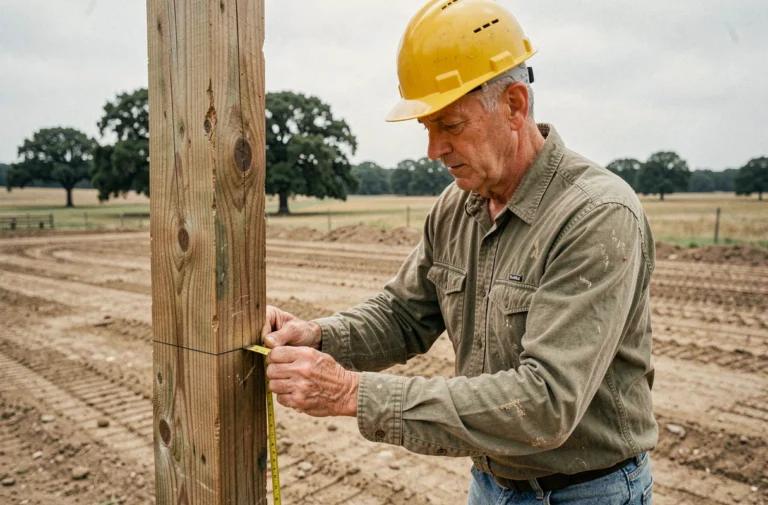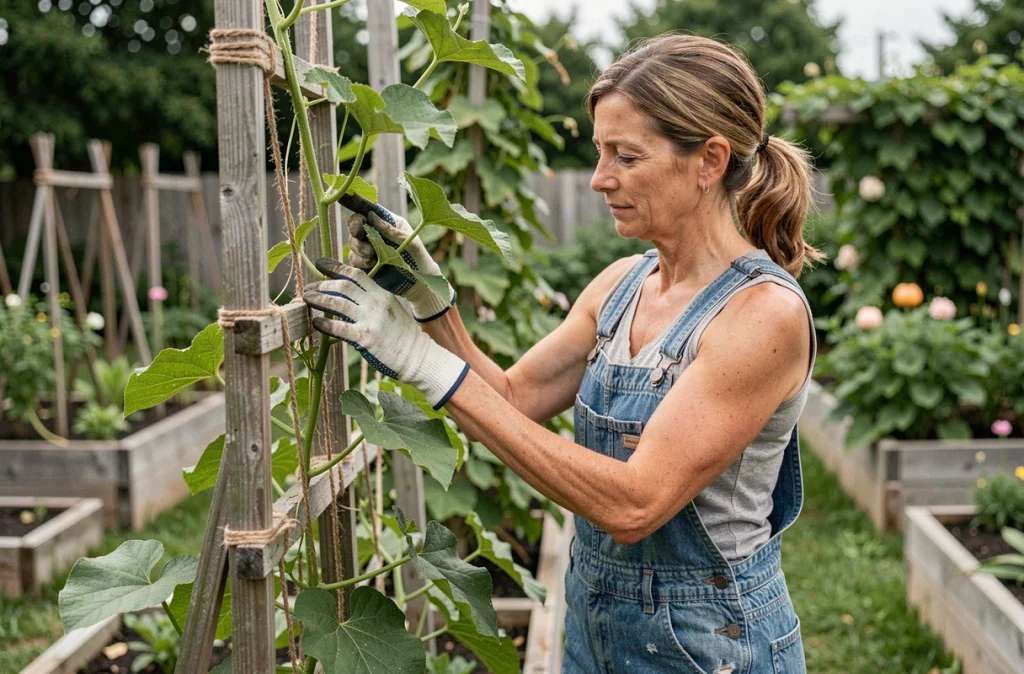
Butternut (Cucurbita moschata) is a sprawling squash whose stems can extend several meters along the ground. Growing this plant vertically frees up space in the vegetable garden while keeping leaves and fruits off the damp soil, which reduces the pressure from fungal diseases and facilitates visual inspection of the stems.
Mechanical constraints of butternut on a vertical support
Butternut produces fruits whose weight gradually increases over the season. Unlike a zucchini or cucumber, the mature fruit exerts prolonged tension on the stem and the support. Training butternut requires a support capable of bearing this load without bending.
The sprawling and fuzzy stems of this winter squash do not cling spontaneously like a vine. They produce tendrils, but these lack the strength to support the weight of a developing fruit on their own. Therefore, the stems must be manually guided along the structure and secured at regular intervals.
Mastering the vertical cultivation of butternut involves understanding this dual constraint: the strength of the support and the active guidance of the stems throughout their growth.
Which trellis to choose for training butternut
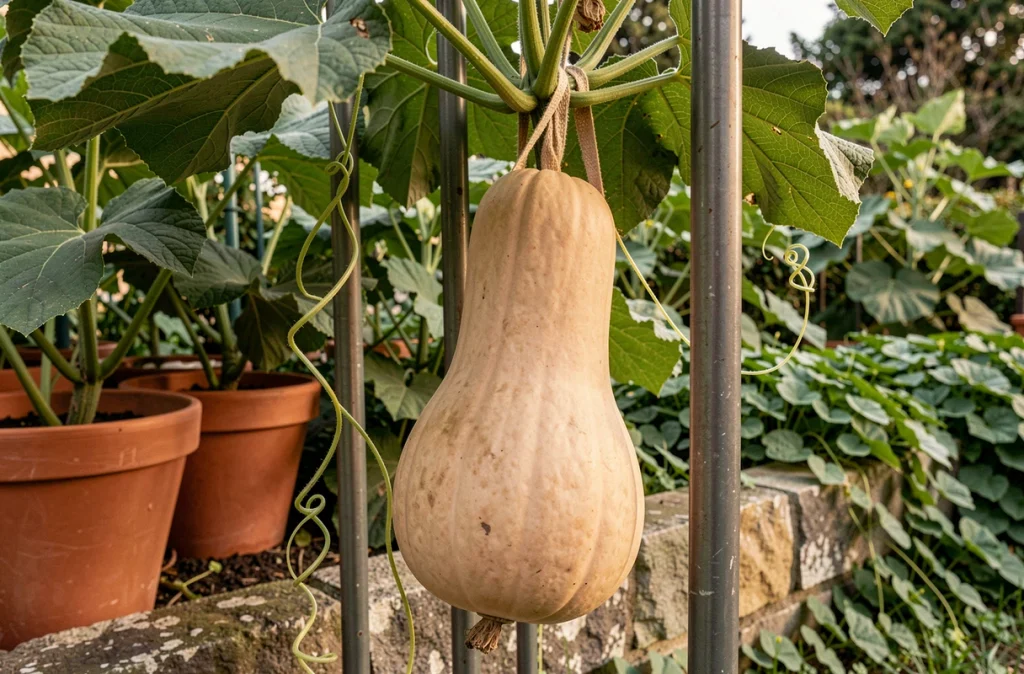
A lightweight wooden trellis or a soft plastic net is suitable for climbing beans, but not for squashes. For butternut, a rigid panel or a treated wooden frame, securely anchored in the ground or attached to a wall, fence, or deeply driven posts is required.
A welded metal support or sufficiently thick wood remains the most reliable choice. Metal mesh panels, fixed between two posts, provide a dense gripping surface and adequate mechanical strength.
Some criteria for sizing the structure:
- The useful height should reach at least the height of an adult, allowing the stems to grow without bending down too quickly.
- The mesh of the support should be wide enough to pass a hand through and attach the stems, but tight enough to provide regular gripping points for the tendrils.
- The posts or anchors must withstand wind loaded with foliage: the wind resistance of a vertically trained butternut in mid-summer is significant.
Supporting suspended fruits: nets and individual hammocks
When the fruits begin to grow, their weight directly pulls on the peduncle. Without support, the fruit may detach before maturity or break the stem that carries it. Each fruit must be individually supported as soon as it exceeds the size of a fist.
The most common technique involves slipping the fruit into a fine mesh net (like an onion bag or an old pantyhose) tied directly to the trellis. This transfers the weight from the peduncle to the support. This operation is done progressively as the fruits develop.
Limiting the number of fruits per plant
In vertical cultivation, keeping too many fruits per plant compromises both the strength of the training and the size of the harvested squashes. Removing excess female flowers after the setting of two or three fruits allows the plant’s energy to be concentrated. The remaining fruits grow better, and the support bears a reasonable load.
Inspection of stems and pest prevention in vertical cultivation
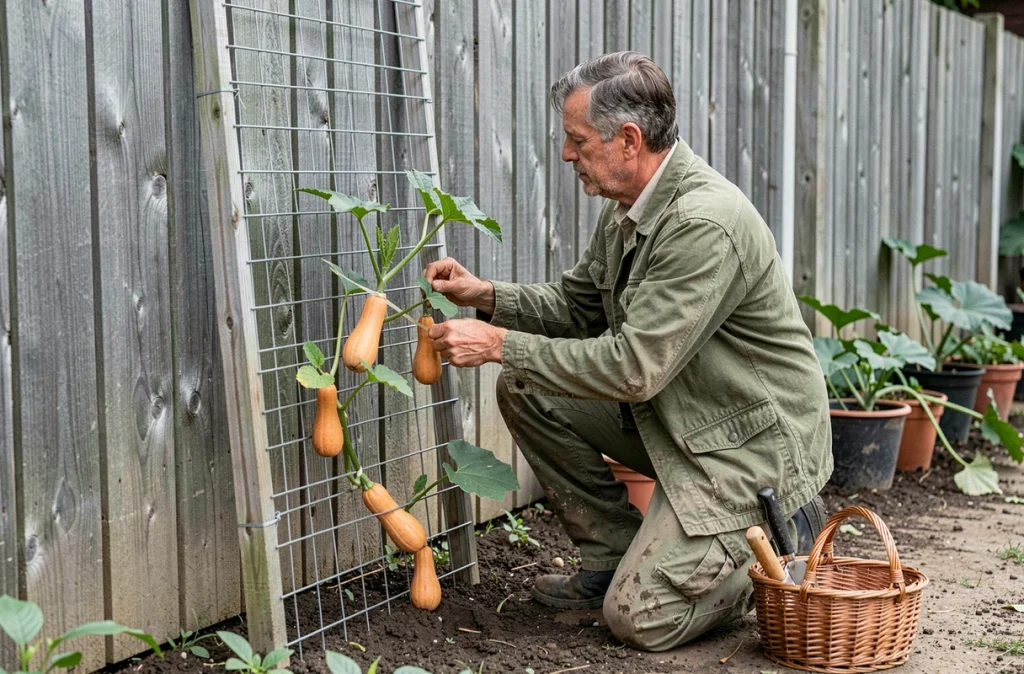
A direct advantage of training: the stems are visible along their entire length. Butternut is considered relatively less susceptible to the squash vine borer than other cucurbits, but vigilance is still necessary.
Weekly inspection of the collar and the first few centimeters of the stem allows for the detection of eggs and early signs of infestation before the larva settles in. In a vertical position, this area is accessible without bending down or turning the foliage, making control much quicker than in sprawling cultivation.
If a stem shows signs of wilting or rot, it must be removed and disposed of, not composted. Strict sanitation of infested stems limits the spread of the pest from one season to the next.
Leaf aeration and fungal diseases
Vertical foliage dries faster after rain or watering. Powdery mildew, common on cucurbits at the end of the season, develops less easily when air circulates freely around the leaves. Pruning the lower leaves that still touch the ground enhances this effect.
Soil, watering, and exposure for vertical butternut
Vertical training does not change the fundamental needs of the plant. Butternut remains a vegetable that requires heat, sunlight, and organic matter.
- Sowing is done in pots under cover or directly in the ground once the soil is well warmed. The plants should have rich soil, amended with well-rotted compost.
- Full south exposure is preferable: the plant needs at least six hours of direct sunlight per day to fruit properly.
- Watering should target the base, not the foliage. A thick mulch on the ground retains moisture and limits weeding around the base of the trellis.
A trained butternut consumes as much water as a sprawling butternut, sometimes more if the trellis is exposed to wind that accelerates evapotranspiration. Monitoring soil moisture remains the best method to adjust watering frequency.
Harvesting occurs when the peduncle begins to lignify and the skin resists the pressure of a fingernail. In vertical cultivation, this moment is easier to spot since each fruit, suspended in its net, is visible without effort.