A stuck screw in drywall is a problem in itself. Drywall is neither solid wood nor metal: it is a gypsum board sandwiched between two sheets of cardboard. Pulling too hard tears the cardboard, enlarges the hole, and turns a simple task into a patching project. Before forcing with a screwdriver, you need to identify what is causing the screw to stick and adapt the technique to the material.
Loose screw or screw in a Molly anchor: two very different situations in drywall
The first thing to check is whether the screw is driven directly into the gypsum or if it goes through an expansion anchor like a Molly. Do you see a metal collar around the screw head? That’s a Molly anchor. This distinction radically changes the approach.
A loose screw in drywall often gets stuck because the gypsum has compacted around the threads, or because the head has sunk and lost its grip. In this case, we only work on the screw.
With a Molly anchor, the screw is tightened in a metal sleeve whose wings have expanded behind the board. Pulling straight out will tear a piece of drywall. Several methods for removing a stuck screw take this peculiarity into account, and that’s what makes the difference between a clean extraction and a gaping hole.
Always identify the type of fastening before choosing your tool. Skipping this step risks turning a small problem into a major repair.
Extracting a stuck screw with a usable grip
When the screw head protrudes from the wall and the grip (cross or flat) is not too damaged, start with the gentlest method.
The rubber band trick on the grip
Place a wide flat rubber band between the screw head and the screwdriver. The rubber band fills in the micro-damage of the grip and increases adhesion. Press firmly while turning counterclockwise. This technique works on slightly rounded grips, not on a completely smooth head.
The impact screwdriver to free the threads
An impact screwdriver combines an axial shock with rotation. Position the bit in the grip, then strike the handle with a hammer. The shock breaks the bond between the threads and the compacted gypsum. On drywall, you need to strike moderately: a sharp blow is enough, no need for brute force. Gypsum is brittle, and excessive power will drive the screw in instead of freeing it.
Screw with damaged head in drywall: create a new grip
The grip is completely smooth, rounded from failed screwdriver attempts? You need to create a mechanical grip.
Notch the head with a hacksaw or a disc
If the head protrudes enough, use a mini hacksaw (or a rotary tool with a fine disc) to carve a slot in the head. This slot then allows you to use a flat screwdriver to unscrew normally. The slot must be deep enough for the screwdriver blade to engage without slipping.
The locking pliers for direct grip
When the head protrudes by at least one or two millimeters, locking pliers provide a solid grip. Clamp the jaws onto the head and turn slowly. Do not pull towards you: turn in the direction of unscrewing. Pulling straight out on drywall will surely tear the cardboard.
Screw extractor for drywall: when and how to use it
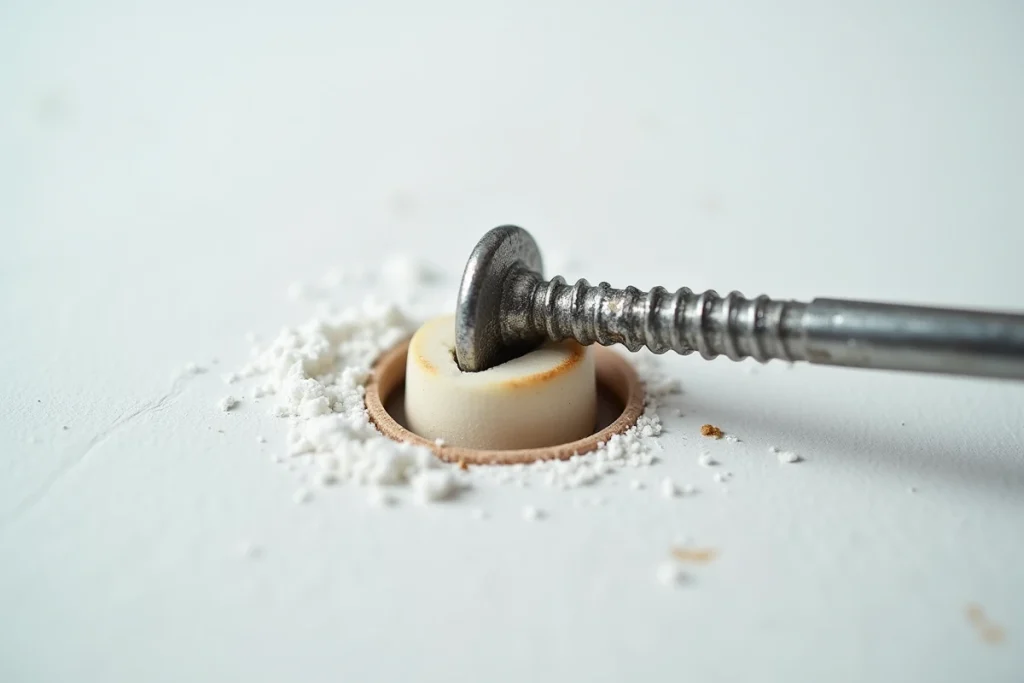
The screw extractor is the last resort tool when the head is broken or completely sunk into the board. The principle: drill a small hole in the center of the screw body with a metal drill bit, then insert the extractor (a conical bit with reverse threads) that grips while turning counterclockwise.
On drywall, two special precautions:
- Use a small diameter drill bit, suitable for the size of the screw, to avoid enlarging the hole in the gypsum board
- Drill at low speed and without excessive pressure, as drywall does not hold the screw as firmly as hardwood or metal
- If the screw is in a Molly anchor, the extractor will not solve the problem of the anchor itself, which will remain stuck behind the board
A screw extractor kit with several diameter drill bits covers most cases. Make sure the kit includes metal drill bits if your screws are made of hardened steel.
Stuck Molly anchor: push rather than pull
You have removed the screw, but the Molly anchor remains stuck in the drywall with its wings deployed behind the board? Don’t pull on it. That’s the natural reflex, and it’s the worst.
Push the anchor into the cavity of the wall rather than tearing it out from the front. With a screwdriver or a nail punch, press on the collar to tilt the anchor inside the wall. It will fall into the space between the two drywall boards. This method preserves the cardboard and limits the size of the hole to patch.
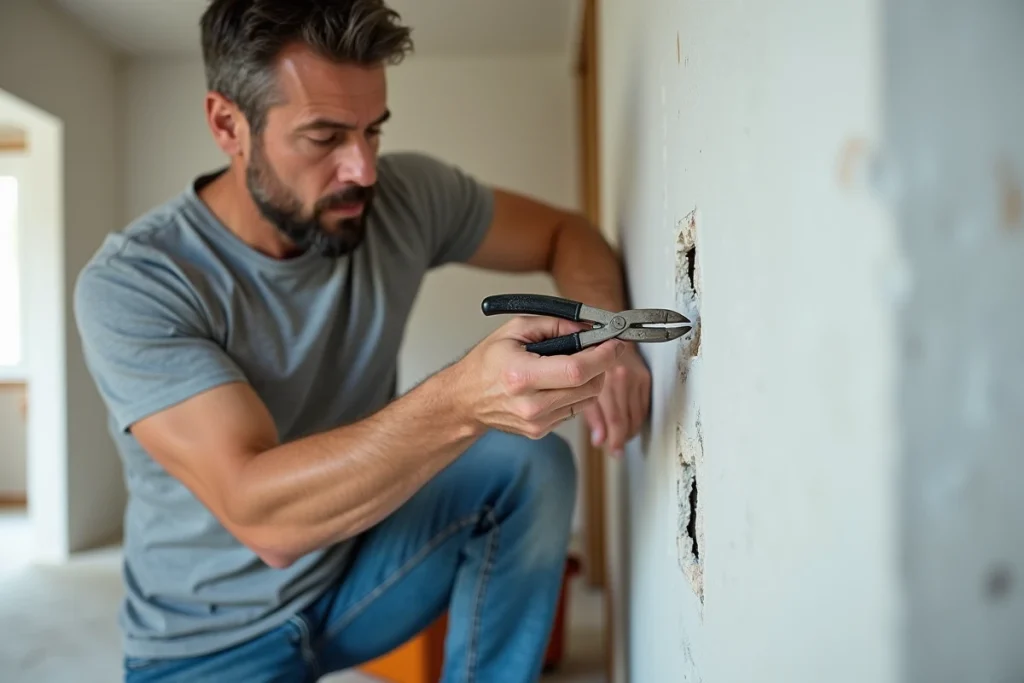
If the collar resists, cut it flush with the wall using cutting pliers, then push the rest. The remaining hole can be easily patched with a filler and a spatula.
Patching properly after extracting a screw in drywall
Extraction is only half the job. A poorly patched hole in drywall is immediately visible, especially in low light.
- For a small diameter hole (loose screw), a filler applied in two thin layers is sufficient, with light sanding between layers
- For a larger hole (torn Molly anchor or damaged cardboard), first glue a strip of mesh tape or a piece of fiberglass mesh before applying filler, to prevent the filler from cracking
- Wait for complete drying before sanding and repainting, otherwise the filler will shrink and the repair will sink
Patching in two thin layers is better than one thick layer. Thick filler cracks as it dries, especially on holes larger than one centimeter.
Drywall does not tolerate brute force well, but it repairs nicely when the screw has been extracted cleanly. Choosing the right technique from the start saves you an hour of patching and sanding later.