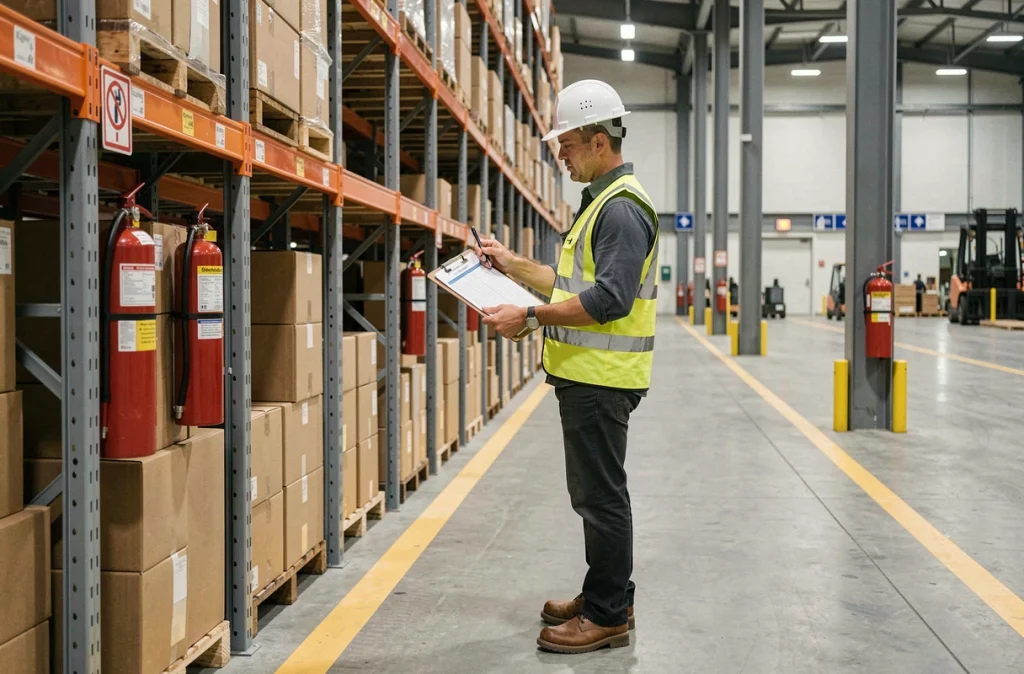
A forklift crossing a pedestrian at the end of an aisle, a poorly secured pallet sliding off a shelf, a fire starting in a storage cell: these situations occur every week in warehouses that are supposedly equipped. The probability of accidents in the transport and logistics sector is significantly higher than the average of other sectors.
Protecting a warehouse is not limited to putting up signs: it involves the very design of flows, the choice of locks, and the sizing of fire protection systems.
Containment of extinguishing waters and ICPE compliance: the blind spot of warehouses
Most warehouse safety guides talk about fire extinguishers, sprinklers, and smoke detectors. They rarely address what happens after these systems are triggered: where do the polluted extinguishing waters go?
Since the post-Lubrizol regulatory package of September 24, 2020, warehouses classified under ICPE 1510 must meet enhanced requirements. The compliance timeline runs until January 1, 2026, for compartmentalization and retention. Operators must now separately size the need for extinguishing water (D9 guide, increased by a flat margin of 20%) and the volume of retention for polluted waters (D9A guide).
In practical terms, this means checking the condition of valves, the separation between rainwater, industrial, and extinguishing networks, and documenting each test. A fire defense plan is required for all warehouses, regardless of their regime, with the capacity to provide emergency services with an accurate status of stored materials.
Warehouse security practices therefore go beyond visible equipment: they include document management, traceability of controls, and crisis management preparation.
Physical security of access in logistics warehouses
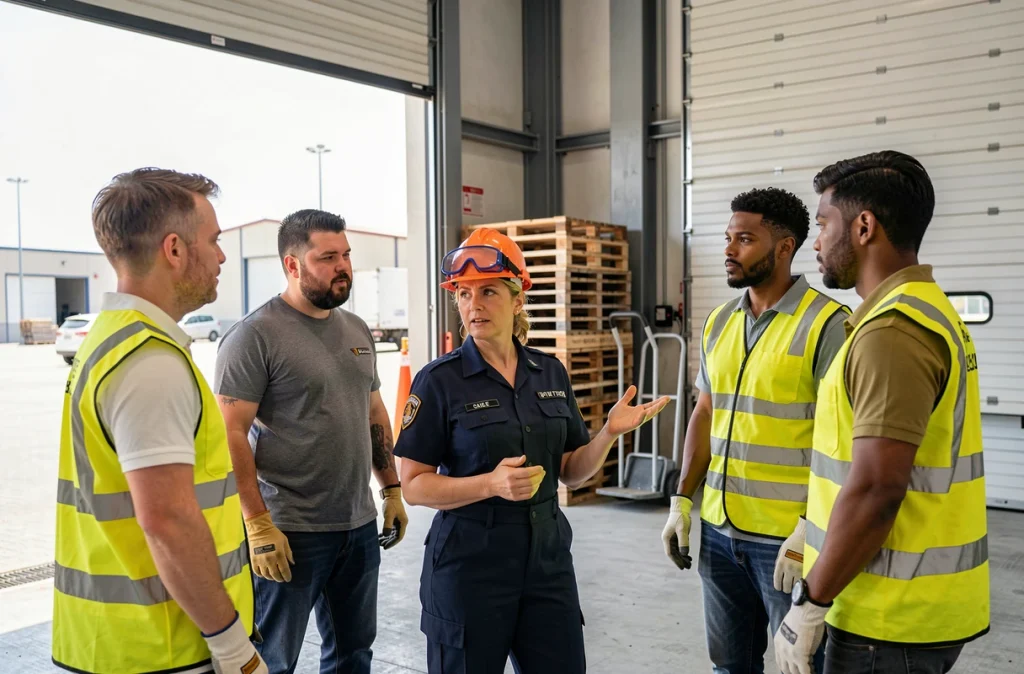
Have you ever noticed that a warehouse can have dozens of entry points? Dock doors, pedestrian access, gates for heavy trucks, emergency exits. Each of these points represents a vulnerability if access control is poorly designed.
The theft of goods in warehouses and logistics sites poses an increasing strategic risk for supply chains in Europe. Losses related to theft in warehouses often exceed those during transport, as sites concentrate large volumes of goods in one location.
Three levels of physical protection deserve special attention:
- The outer perimeter: fences, anti-intrusion barriers, and deterrent lighting. A poorly lit site at night attracts break-in attempts much more than a site visible from the public road.
- Main access points: high-security locks, badge or code systems, airlocks for deliveries. The quality of the locking system determines resistance to break-ins much more than the presence of a camera.
- Internal sensitive areas: mesh cages for high-value products, secure cabinets for documents, restricted access by area according to employee profiles.
Video surveillance complements this system but does not replace it. A camera records a theft, it does not prevent it if the door opens with a simple screwdriver.
Protection of teams and circulation areas in warehouses
Each year, a significant portion of workplace accidents in warehouses comes from lifting heavy loads, falls from heights, and loss of control of handling equipment. These three categories of risks require distinct responses.
Physical separation between pedestrians and machinery
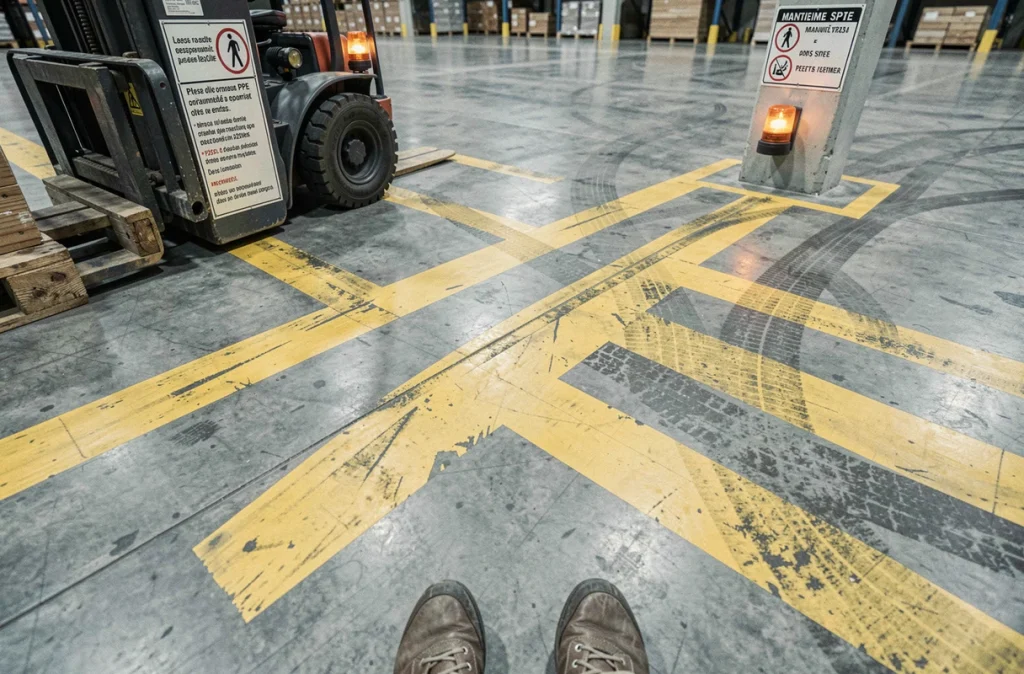
Floor marking is not enough. Protective barriers, anti-collision posts, and guardrails create a real separation between forklift traffic areas and pedestrian aisles. Why this distinction? Because a hurried operator naturally takes the shortest path unless a physical obstacle prevents them.
Shelving and periodic inspection
A shelving unit deformed by a collision with a cart loses part of its load-bearing capacity. Annual inspection of shelving is a regulatory obligation, not a recommendation. It must be carried out by a competent organization that classifies each damage according to three levels: green (monitoring), orange (intervention within four weeks), and red (immediate unloading).
Between inspections, teams must report any visible impact. A bent upright or a sagging beam can cause an entire bay to collapse.
Team training and prevention culture in warehouses
Personal protective equipment (helmets, safety shoes, high-visibility vests) only protects if worn. And they are only worn if employees understand why.
Annual training for employees is the foundation of any prevention approach. It covers the operation of equipment, handling techniques, evacuation procedures, and knowledge of stored products. For ICPE warehouses, this training now includes crisis management and handling of containment devices.
A often overlooked point: temporary and interim workers. They represent a variable but regular part of the workforce in logistics warehouses. Their safety onboarding must be formalized, with a tour of high-risk areas and the provision of protective equipment before any job assignment.
- Documented safety onboarding for each newcomer, including temporary workers and subcontractors.
- Evacuation drills at least once a year, with a realistic scenario (fire, chemical leak).
- Display of safety instructions at every intersection of zones, updated after each layout change.
The storage of lithium batteries in logistics warehouses is also receiving increasing attention. These products present thermal runaway risks that conventional extinguishing systems do not address in the same way. Regulations on lithium battery storage are still evolving, which requires active monitoring by operators.
Protecting a warehouse involves coordinating three layers: regulatory compliance (ICPE, shelving inspection, fire defense plan), physical security of access (locking systems, access control, video surveillance), and the competence of teams on the ground. Neglecting any of these layers undermines the other two.